


Mobile Perfume Filter Machine, Stainless Steel Perfume Filtration Equipment for Cosmetic Liquid Purification
spx-ppf-26612
designed to purify perfume, essential oils and other cosmetic liquids. Made of stainless steel, it effectively removes impurities and particles to improve product clarity and stability. With a movable design, it is easy to connect with different production lines and convenient for cleaning and maintenance.
Quantity:


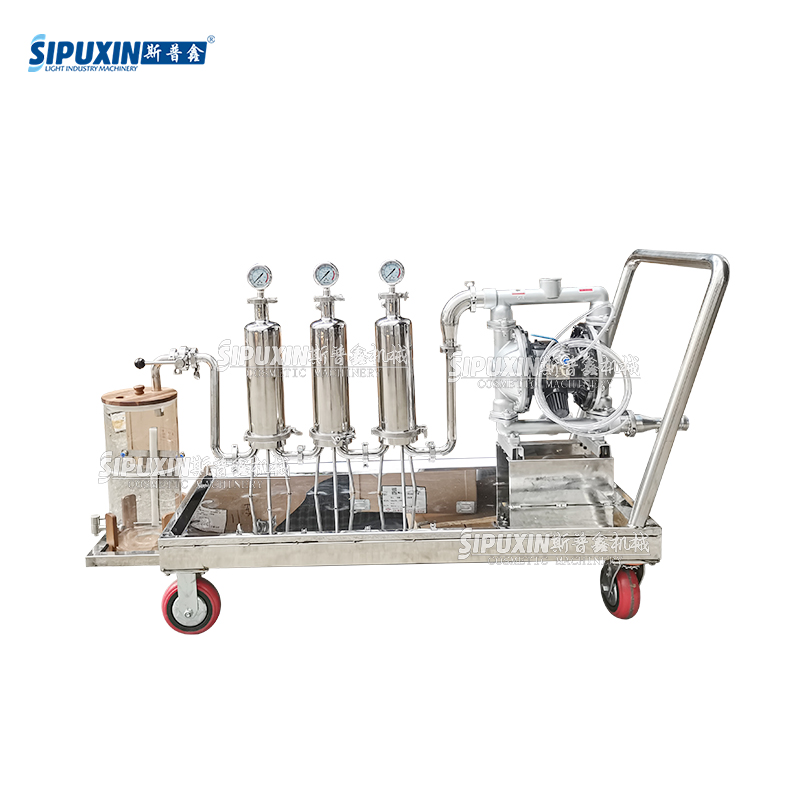
SIPUXIN mobile perfume filter is a high-efficiency, multi-stage filtration system designed for perfume, essential oils, toners and other cosmetic liquids.
Made of food-grade stainless steel, it features three precision filter cartridges that effectively remove impurities and suspended particles, improving product clarity, stability and shelf life.
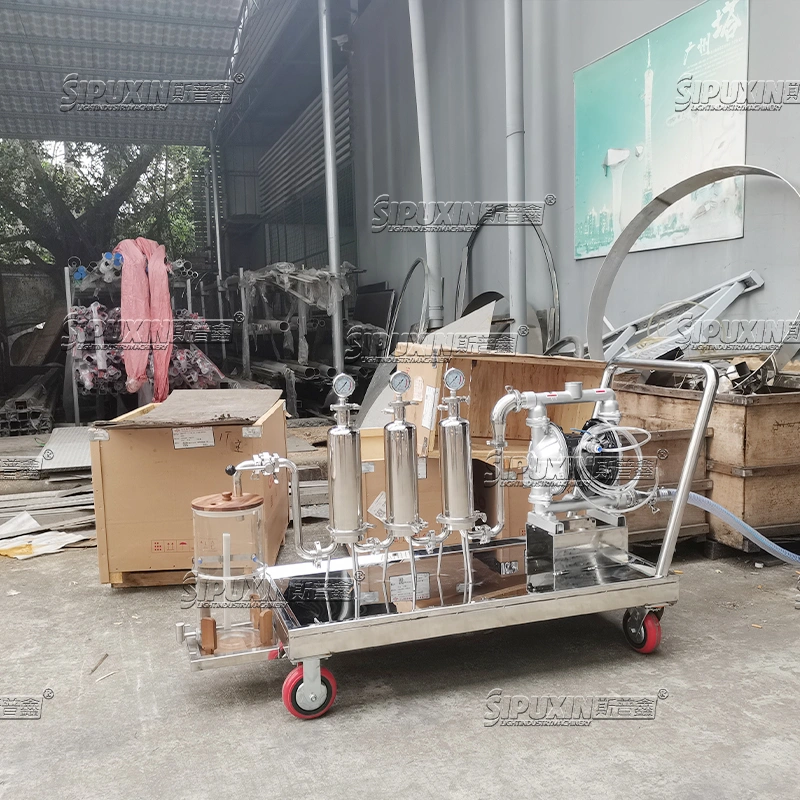
The compact trolley design with casters and handle allows easy movement between production lines, while the diaphragm pump ensures smooth and continuous operation.
Easy to disassemble, clean and maintain, it is an ideal solution for small to medium cosmetic factories to purify liquid products.
| Item | Specification |
|---|---|
| Model | SIPUXIN Perfume Filter |
| Application | Perfume, essential oil, toner, floral water, and other cosmetic liquids |
| Filter Stages | 3-stage filtration system |
| Filter Cartridge Material | 304/316 stainless steel |
| Frame & Body Material | Food-grade 304 stainless steel |
| Pump Type | Diaphragm pump |
| Operation Type | Mobile trolley design with casters and handle |
| Filtration Precision | Customizable (0.22μm, 0.45μm, 1μm, 5μm optional) |
| Cleaning Method | Detachable structure for easy disassembly and sterilization |
| Hygiene Standard | Meets cosmetic industry hygiene requirements |
production description
1. Stainless Steel Trolley & Frame
The entire unit is mounted on a heavy-duty, food-grade 304 stainless steel trolley.
It is equipped with four heavy-duty casters (two with brakes) and an ergonomic push handle, allowing the filter to be easily moved between production tanks, filling lines, or cleaning stations. The frame is fully welded and polished, providing a stable and corrosion-resistant base for all components.
2. 3-Stage Filter Housings & Cartridges
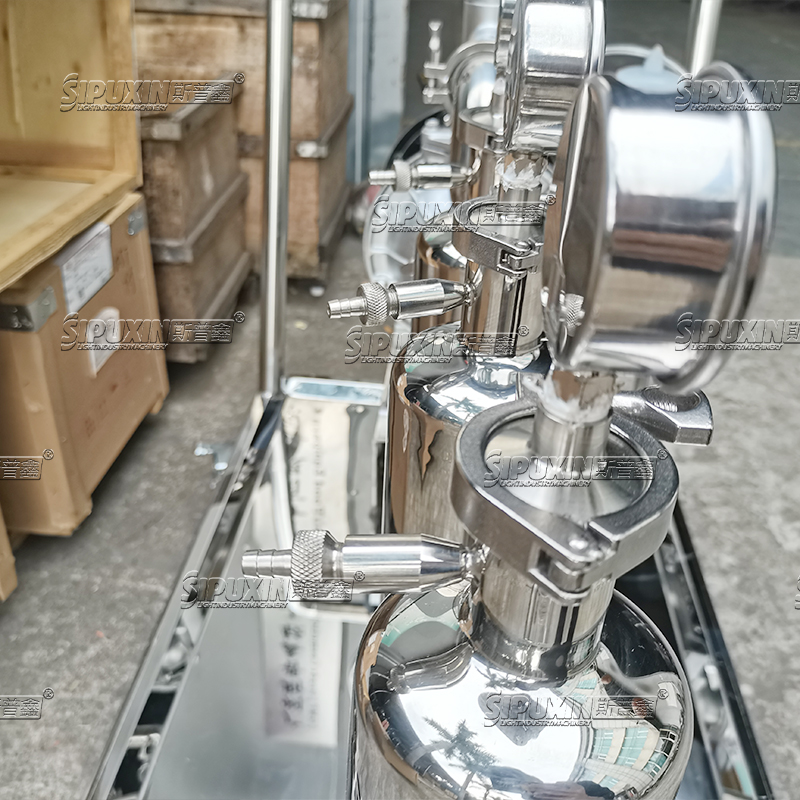
The core of the system consists of three vertically arranged stainless steel filter housings, each fitted with a pressure gauge.
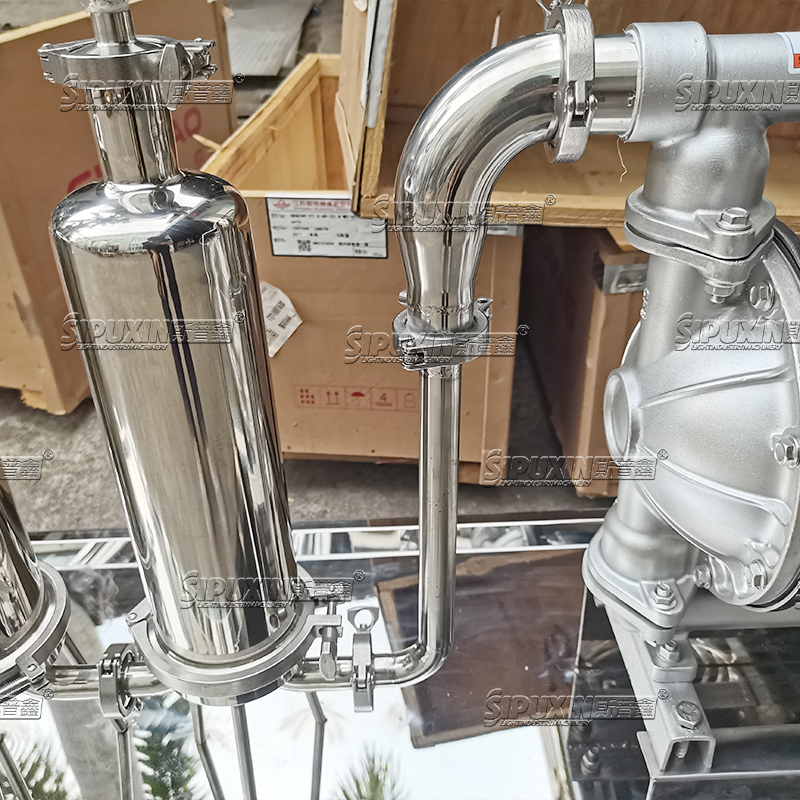
These housings use sanitary clamp connections, allowing for quick disassembly and filter cartridge replacement.
• First stage (coarse filtration): Removes large particles and sediments.
• Second stage (fine filtration): Eliminates fine suspended solids.
• Third stage (sterile filtration): Polishes the liquid and removes microorganisms, ensuring clarity and extending shelf life.Filter cartridges are available in various precision ratings (0.22μm to 5μm) to suit different liquid types.
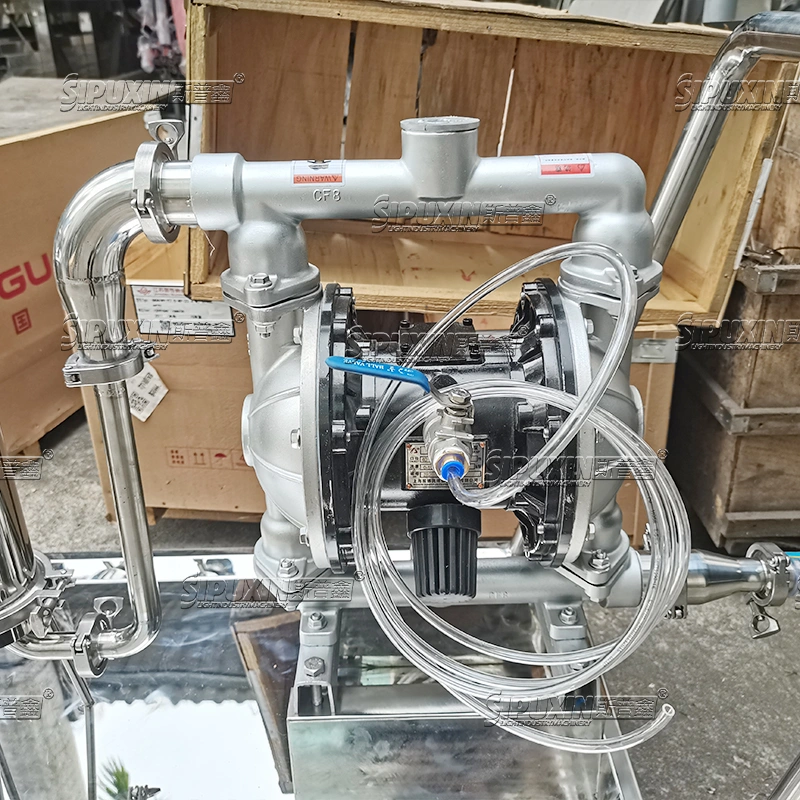
3. Pneumatic Diaphragm Pump
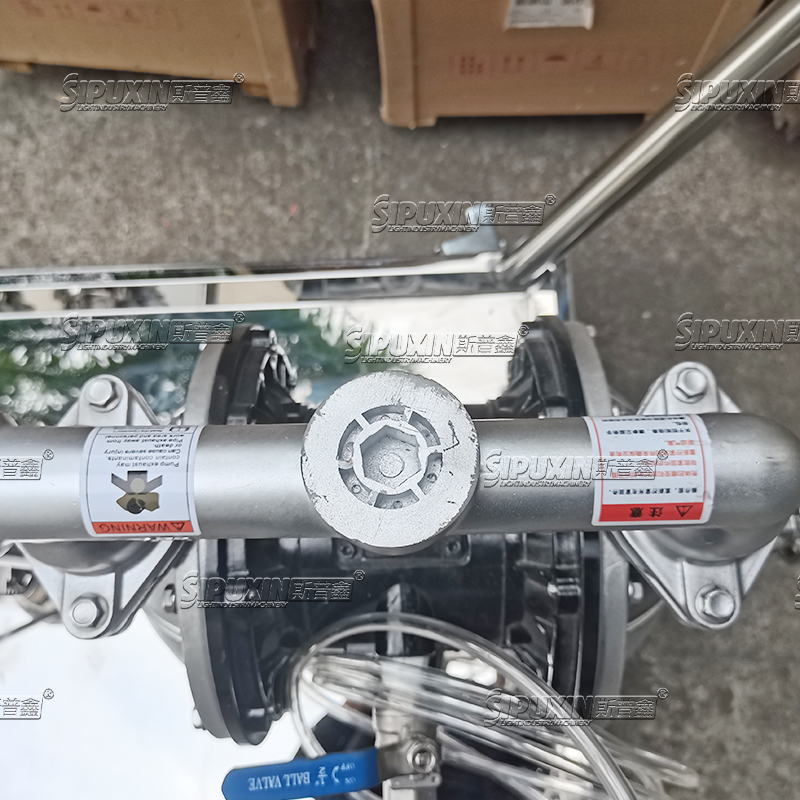
An air-operated double diaphragm pump is installed as the power source for liquid transfer. This type of pump is ideal for low-viscosity, volatile liquids like perfume, as it operates without electricity, preventing sparks and leaks. It is self-priming and can handle liquids containing small particles without damage, ensuring a smooth and continuous filtration process.
4. Piping, Valves & Instruments
All wetted parts, including pipes, valves, and fittings, are made of 304/316 stainless steel, meeting GMP hygiene standards. Sanitary ball valves are installed at the inlet, outlet, and bypass points for easy flow control and system draining. Pressure gauges on each filter housing monitor internal pressure, allowing operators to detect clogging in real time.
5. Transparent Receiving Container A transparent receiving cup is included for collecting the filtered liquid or for observing the filtration effect. It is connected to the system via sanitary fittings, allowing for easy sampling or temporary storage of the processed liquid.
Operation Instructions
1.Pre-Use Preparation
◦ Inspect all components, pipes, and fittings to ensure they are clean and properly connected.
◦ Install the desired filter cartridges into the filter housings and tighten the sanitary clamps securely.
◦ Connect the air supply line to the pneumatic diaphragm pump and adjust the air pressure to the recommended working range (typically 0.2–0.6 MPa).
◦ Connect the inlet hose to your raw material tank and the outlet hose to a clean, filtered liquid collection tank.
2. Priming and Starting the System
◦ Open the inlet and outlet ball valves fully.
◦ Slowly open the air supply valve to start the diaphragm pump. The pump will begin drawing liquid from the source tank.
◦ Observe the liquid flow. Check for leaks at all connections. The liquid will pass through the three filter stages sequentially.
3. Monitoring the Filtration Process
◦ Keep an eye on the pressure gauges installed on each filter housing.
◦ A gradual increase in pressure indicates that the filter cartridges are becoming clogged.
◦ If the pressure rises significantly or the flow rate drops, stop the process to inspect and replace the cartridges.
4. Stopping the Process
◦ Close the air supply valve to stop the pump.
◦ Close the inlet valve first, then open the drain valve to release any residual liquid and pressure from the system.
◦ Disconnect the air line and hoses.
5. Cleaning and Maintenance
◦ Disassemble the filter housings and remove the cartridges.
◦ Rinse all parts with clean water or a suitable cleaning solution. For sterilization, you can use hot water or steam (check cartridge compatibility).
◦ Allow all components to air dry completely before reassembling and storing the unit.
◦ Replace filter cartridges regularly, or immediately if they become damaged or excessively clogged.
Recommend Products
 4 Heads Rotary Vacuum Perfume Filler, Magnetic Pump Automatic Glass Bottle Perfume Filling Machine PLC Driven
 4 Nozzles Air Cleaning Two Nozzles Crimping Collaring Machine 8 Nozzles Perfume Filling Line for Fragrance Perfume Body Mist
 SIPUXIN Hot Sale CE Certified Semi-Automatic Perfume Filling Machine With Rotary Turntable
 Explosion‑proof 200L Pneumatic Perfume Dispersion Tank for Cosmetic Fragrance Production